
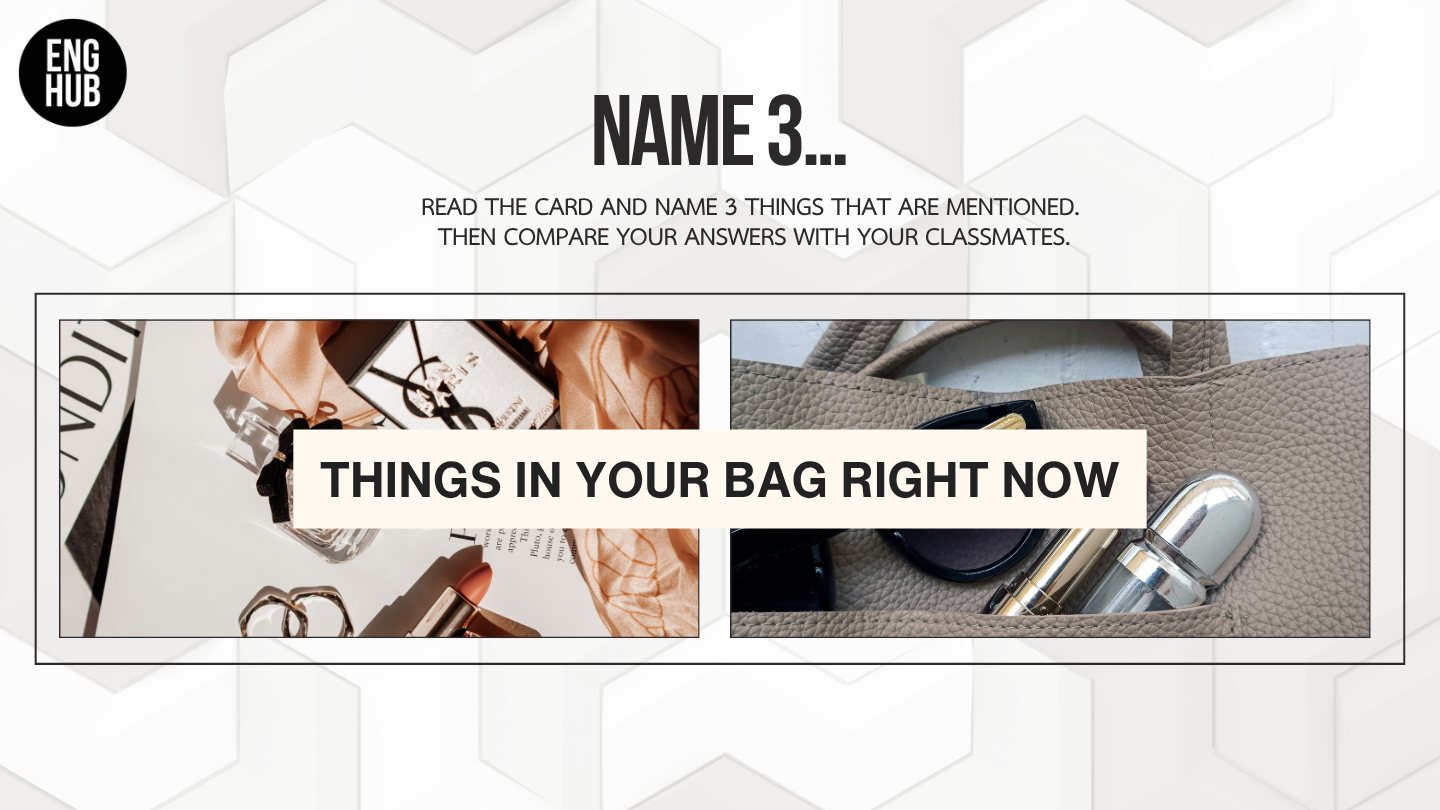
Name 3...6.0
Individual work
- The teacher assigns one or more cards with everyday categories or situations.
- The student says several words or short phrases connected to each card as quickly as possible. Full sentences are not necessary at first.
- The teacher can model possible answers before the activity.
For example:
Things in your bag — “Phone, keys, notebook.”
Breakfast foods — “Toast, cereal, coffee.”
Things you do every day — “Study, cook, walk the dog.”
Encourage quick and natural answers instead of long pauses or detailed explanations.
Pair / Group work (including breakout rooms)
- The teacher assigns one or more cards to each pair or group.
- Students work in pairs or small groups (2–4 students).
- They take turns saying words or short phrases connected to each card as quickly as possible.
- Partners can ask simple follow-up questions or add more ideas to the list.
Encourage students to:
* speak without long pauses
* add extra ideas
* react to their partner’s answers
* ask simple questions
Class sharing
Invite some students or groups to share their answers with the class.
The class can discuss:
* the funniest answers
* the most popular ideas
* unusual or different answers
* which cards were easy or difficult
Focus on fluency, confidence, quick thinking, and active participation in English.
Extra ideas
* Students continue each other’s lists without repeating words.
* Students try to give the longest list in one minute.
* Students choose the fastest speaker in the class.